

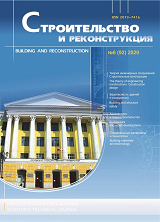
“Stroitel'stvo i rekonstruktsiya” (“Building and Reconstruction”) is an international peer-reviewed journal dedicated to current issues and research in the field of construction, architecture, urban planning and related research areas. The journal publishes new scientific articles, as well as scientific reviews on the following topics:
- Building constructions, buildings and structures;
- Soils and foundations, underground structures;
- Structural mechanics;
- Construction materials and building products;
- Technologies of construction;
- Heat supply, ventilation, air conditioning, gas supply and lighting;
- Environmental safety of construction and urban economy;
- Architecture of buildings and structures. Creative concepts of architectural activity;
- Urban planning, planning of rural settlements.
Current issue
THEORY OF ENGINEERING STRUCTURES. BUILDING UNITS
The paper presents an analytical methodology and a computational algorithm for evaluating the deformation parameters and crack width in reinforced concrete members subjected to eccentric compression combined with torsion. The members are fabricated from lightweight high-strength concrete. The proposed approach is based on the equilibrium equations for a spatial cross-section, the hypothesis of a spatial cracking surface, and the incorporation of the strain effect along the crack faces intersected by a reinforcing bar. A comparative analysis is carried out between the analytical predictions and experimental data on the deformation behavior and crack opening characteristics of the structural members under consideration. The experimental program was conducted on specimens made of lightweight concrete of strength classes B40 and B65, with rectangular cross-sections of 100×50 mm. It was found that the failure mode of the members is brittle, governed by the propagation of a single spatial crack developing progressively under loading. A comparison of the calculated crack widths obtained using the proposed methodology with the experimental results demonstrates satisfactory agreement, thereby validating the reliability of the analytical model. The findings highlight the necessity of accounting for the discrete nature of crack formation and the strain effect when assessing crack widths in lightweight high-strength concrete structures.
The article is very strong, highly relevant, and of great practical value. It is based on unique, long‑term experimental data and reveals real contradictions between current standards and the behaviour of modern concretes, offering concrete quantitative corrections. Particularly valuable are the new, previously unpublished findings on the elastic modulus after failure loads and on the influence of humidity on creep. The work is critical yet constructive — the authors not only point out shortcomings but also provide well‑founded solutions. It will be useful for both structural engineers and code developers. Highly recommended for publication in a peer‑reviewed journal.
Modern structures of buildings made of concrete, reinforced concrete and composite steel and concrete are in a complex stress state, which leads to a change in their strength characteristics. In the case of multiaxial compression of concrete, its strength indicators increase, which can be advantageously used in calculations and design of structures. Due to the insufficient study of the issue in modern scientific, technical and regulatory literature, an experiment was conducted to study the behavior of modern, including high performance concrete in a complex multiaxial stress state. Models with steel-plate reinforcement were investigated. The assessment of the behavior of concrete in a complex multiaxial stress state is based on the results of experimental research and analysis of existing international experience. The description of the studied models is presented, the features of the materials used in the manufacture of models and their characteristics are given. Data on experimental equipment, the scheme of testing and loading structures are presented. The general types and nature of destruction, graphical test results are presented. A comparison of theoretical and experimental data is performed.
The article considers a methodology for the probabilistic analysis of a finite-length reinforced concrete beam freely resting on a stochastic elastic foundation with two bed coefficients under the action of a randomly distributed vibration load. The bed coefficients and the external load are treated as random Gaussian stationary functions of the beam coordinate with prescribed correlation functions. To solve the differential equation of the beam’s forced vibrations, the generalized Bubnov-Galerkin method is used in combination with the statistical Monte Carlo method. Cracking is taken into account using a two-stage scheme. At the first stage, the stress-strain state of the uncracked beam is determined, and the sections in which the cracking condition is satisfied are identified. At the second stage, a piecewise-variable stiffness function is formed for each realization, after which the deflections and bending moments are recalculated. As a result, the mathematical means, standard deviations, cracking probabilities, and probabilities of exceeding the allowable deflection along the beam length are determined. The numerical analysis showed that, within the considered example, accounting for cracking has only a minor effect on the probabilistic characteristics of deflections; however, it substantially changes the mathematical means and standard deviations of bending moments due to the redistribution of internal forces.
A method for using simple isothermal diagrams to study the crisis-strain state of concrete under regime-induced thermal-power loading and forced deformation is proposed. The methodological foundations of the study are built on a clear distinction between the concepts of strain additivity and loading non-commutativity, allowing for the adaptation of the classical traditional Boltzmann-Volterra principle to the nonlinear stage of material performance. It is demonstrated that nonlinear strain increments retain the property of physical additivity and can be correctly summed when the history and trajectory of thermal-power effects are taken into account step-by-step. The experimentally observed similarity in the geometric shape of the instantaneous, long-term, and high-temperature strain curves is substantiated in terms of the Unified Physical Law of Deformation of Concrete as a Viscoelastic Gravitationally Brittle Medium. An equation of state in the form of nonlinear Hooke's law is presented, observing the degree of structural damage based on a two-parameter Weibull statistical distribution. This allows for an analytical description of the complete concrete deformation diagram upon heating. A closed-loop algorithm for the transition between deformation and stress phenomena has been developed using intermediate point parameters according to N.I. Karpenko's methodology. It is effective for solving problems of both seasonal loading and seasonal relaxation of concrete.
BUILDING AND STRUCTURE SAFETY
It is proposed to assess the mechanical safety of key structural elements under accidental conditions using an ultimate limit surface formed by the joint consideration of local strength criteria for each type of ultimate internal force, without analyzing a single critical cross-section. Such a surface is constructed for vertical loadbearing elements (columns and pylons) of rectangular cross-section subjected to combined loading. Specifically, cases of eccentric compression with bending moments in the two principal planes are con-sidered, as well as the combined action of axial compressive force, bending moment, and torque induced by the specific features of load application. The calculations are performed in a dynamic formulation accounting for both physical and geometric nonlinearities. A plasticity-based damage model is adopted for concrete, while an elastoplastic model with a bilinear stress–strain diagram and no hardening are used for the reinforcement. The dynamic additional loading is modeled by an impulsive load, the magnitude and duration of which are determined approximately based on the law of conservation of momentum. Such a load simulates an accidental action, for example, the impact of a falling body on a deformable slab at the joint interface with the element. Based on the constructed dynamic ultimate limit surface, an assessment of mechanical safety is performed, which includes not only ensuring the absence of total failure but also accounting for the risk of material losses under various accidental scenarios. Practical aspects of the assessment and the risk calculation algorithm are demonstrated using examples of elements made of normal-weight concrete reinforced with welded frames.
An improved method for calculating reinforced concrete structures has been developed, based on the fundamental principles of the modern phenomenological theory of a non-linearly deformable elastic-creeping body, which takes into account tensor nonlinearity and rheology of deformation together with non-force operational factors. The influence of reinforcement in a three-axis stress-strain state with the condition of joint deformations of concrete and reinforcement is analyzed. Mathematical relations are derived that make it possible to formulate equations for design stresses in reinforced elements. The basic phenomenological equations describing vibration effects are presented, which make it possible to determine the operation of reinforced concrete elements both without cracking and in its presence. An algorithm for linearization of the problem based on integral estimates is proposed, which provides for the fixation of corrosion processes and vibration.
A calculation method for assessing the bearing capacity reserves of large-panel buildings is proposed, considering long-term operational factors (creep, shrinkage, thermal deformations, corrosion, mounting deviations). The method is based on spatial modeling in the LIRA- SAPR software and analytical verification of control elements for strength, crack resistance and deformability. For a nine-story panel building, calculations are performed; for the most loaded wall panel, principal compressive stresses of 7.72 MPa are obtained (utilization factor 0.53); for the floor slab PK 76.15-8, a minimum margin in top reinforcement (η ≈ 1.0) is identified with a significant reserve in deflection (ηf = 0.035). It is established that critical zones are formed in the upper support areas of slabs and vertical joints (shear forces reach 78 % of the experimental ultimate value). The results allow reasonable assignment of inspection scope and repair measures.
This article considers the free vibrations of a reinforced concrete structure with nonlinear flexural stiffness due to the formation and closure of normal cracks and with energy dissipation represented by viscous damping. The calculation model is a cantilever bar loaded with a constant longitudinal force N and an instantly removed transverse load S. The problem is divided into three stages. In the first stage, a nonlinear static problem of bar deflection with a length-varying stiffness dependent on the bending moment level is numerically solved; the coefficient ψs is used to describe the behavior of tensile concrete. In the second stage, the critical damping and logarithmic decrement of vibrations are determined within the framework of a linearly rigid dynamic model with external viscous dampers using the state-space method. In the third stage, a nonlinear dynamic problem is solved, in which the stiffness matrix depends on the current headwall deflection, and the damping matrix is generated taking into account the presence of cracks. The calculations were performed using the MATLAB software package. It was found that for small and moderate transverse loads, the damping coefficient is virtually independent of crack formation. However, as the load approaches its limit, a sharp, power-law-like increase in the dissipative properties of the structure is observed. The resulting relationship allows for a more accurate assessment of damping in reinforced concrete elements when calculating dynamic loads.
CONSTRUCTION MATERIALS AND TECHNOLOGIES
The article discusses the effect of a complex nano modifier on shrinkage deformations of cement-sand concrete. It is indicated that the introduction of a certain number of cellulose nanofibers into the mixture inhibits the deformation of the cement matrix and, thus, significantly reduces shrinkage, but at the same time can lead to a decrease in the strength of the composite at an early age. In order to compensate for the negative effects, the possibility of using a complex modifying system, including a superplasticizer, nanocellulose and a modifier consisting of nanoparticles of various nature, has been studied. The results of studies of the effect of the composition of a complex nanomodifier on shrinkage and strength of fine-grained concrete are presented. A rational combination of components has been established to reduce shrinkage deformations while maintaining the strength characteristics of the material.
The article addresses the pressing issue of transitioning from deterministic design methods for reinforced concrete structures to probabilistic models that require high precision in defining the initial mechanical characteristics of concrete. The authors propose a scientifically grounded approach to standardizing the strength and deformation parameters of concrete, which minimizes subjectivity during data preparation for finite element modeling. The paper presents an algorithm for transforming standard values into the mean values required for numerical analysis in software packages (using Ansys as an example). The proposed approach was verified by comparing the simulation results of a reinforced concrete beam with experimental data. It was found that the discrepancy in ultimate load and maximum deflection does not exceed 5.54%, indicating the high reliability of the proposed methodology. This approach allows design engineers to more accurately account for the actual variability of material properties, thereby increasing the reliability and cost-effectiveness of constructed facilities. The work contributes to the development of numerical model validation methods in structural mechanics.


